Showing posts with label High risk merchant service provider. Show all posts

Saturday, 20 December 2014

Mistakes to Avoid When Choosing a High Risk Merchant Account Service Provider


If you are a high risk business, whether by definition or certain other associating factors, there is more than one way by which you could get your merchant account wrong. Applying for the right merchant account is absolutely essential when it comes to high risk business types and here are some mistakes that you need to avoid.


Here the name does count – If there is one place in the market where name actually counts, it would be the card processing market. You can always be tempted by cheaper rates, and lesser clauses while choosing your merchant account provider, but more often than not it is just better to go with the tried and trusted names in the market. 

Charges – Albeit with the reputation of a provider, charges per processing cycle and other maintenance or extra charges have to be taken into consideration. Your high risk merchant account service should not be a load on your business model, such that it begins to creep into your board meetings and strategies as a thing to mitigate.

Currencies – Always choose a merchant account that processes most currencies otherwise the whole point of planning internationally goes out of the window.

Limits – Businesses often overlook the factor of lower and upper limits set by merchant account providers for the sales cap of the company. This is primarily down to lack of foresight or planning. For a business to be able to sustain in terms of longevity, it is necessary that your service provider has lenient upper and lower limits.

Chargebacks – Do not ever go for a merchant account that treats chargebacks as the greatest evil in the market. While they are deterrents, your merchant account should have the faculty to deal with them and be flexible when dealing with penalties and high volume.

Wednesday, 5 November 2014

High Risk Merchants – Avoid Making These Common Mistakes


Most banks are wary of high risk merchants, as they sometimes cause the greatest losses in their books. This is the main reason why businesses classified in high risk category pay greater fees to the bank than the others. If high risk merchants keep the following points in mind, they are sure to make lesser mistakes. 


1. Keep the dispute numbers to minimal.
Too many disputes will lead to too many extra fees for processing and clearing the issues. Merchants can ensures that there are lesser disputes by laying down clear cut processes to ensure maximum customer satisfaction to each and every client. They should ensure that refunds are released promptly, before a dispute is even filed.
2. Keep the chargeback ratio down
The moment a merchant follies to solve a dispute amicably the credit card company will raise a chargeback in order to process the refund on the client’s behalf. All smart merchants should avoid such a scenario as the charge back costs charged by the banks is too high and eats away profits.
3. Unusual And Abnormal Transactions
A merchants should be instantly alarmed when he notices unusual activity and multiple transactions in a short period of time. Banks get very cautious of unusually high volumes and expect the merchant to keep them informed of any clearance sales or other high revenue planned activities.

Thursday, 16 October 2014

Is Your Business High Risk? What Does It Really Mean?


Businesses, especially the smaller one face a number of roadblocks while applying for merchant accounts. One of the major roadblocks out of these is the one where your business is deemed as “high risk.” High risk businesses need specialized high risk merchant accounts in order to be able to process payments online.
A high risk business is basically one where there is a potential of significant loss, due to the market fluctuations or simply because of the nature of the business itself. The factors, based upon which a business is classified as high risk or not have been listed below for better clarity:


Credit score – An evaluation of your financial banking and the sources of your investment goes a long way in categorizing your business. If there are grey areas or shoddy details, you will run the risk of being struck down by the high risk name.
Risk industries – Some businesses or industries are by definition considered to be high risk. For example, adult services, online pharmacies etc. all have the potential to come into the public-legal crossfire, a risk that most banking merchants are unwilling to take. All such businesses tie up with high risk processors to meet their payment processing needs.
Charge backs – The number of charge backs the business suffers on an average goes a long way in determining whether it is high risk or not. A high number of charge backs means that you are not doing your job properly and that there is a good chance things won’t improve anytime soon.
Roadmap – While history largely does not matter - you may have had bad times recently – if there is scope to grow and improve, there will be no problem. If, however, there are no signs of improvement for the near future, you will be considered as high risk.

Friday, 26 September 2014

Obtaining a Merchant Account with Bad Credit


If you want to accept credit cards from your customers, you’ll be required to have a merchant account in place. Different merchant processors practice different criteria for approving merchant account applications. Your credit will be checked at the time you apply for a merchant account, but don’t fret as merchant processors are usually lenient with customers with bad credit.
Here’s what you need to consider when applying for a merchant account processor:


1.    Business Structure
It depends upon the type of business you’re setting up as to whether your bad credit will play any role in obtaining the high volume merchant accounts from your processor. A limited company will not reflect on the personal account of the business owner, whereas a company which has not been registered, will.
2.    Higher Fees
It is possible to obtain global merchant processing account even if you have a bad credit, but be prepared to pay higher cost for the fees charged. If your business ventures isn’t a limited company and you’re looking for online credit card processing services, it is advisable you prepare your financial credit score well in advance. Doing this will not only reduce the fees charged, but will also save money for your business.
3.    Bankrupt
Your bankruptcy details will reflect on your personal score for nearly ten years.  It will restrict many credit card processors from accepting your application, but there are merchant account providers who will willingly take your high risk business.

Tuesday, 9 September 2014

Credit Card Merchant Account vs. 3rd Party Processor


Business owners should be glad to know that by hiring the services of a third part credit card processor they will be able to accept transactions through credit cards. Merchant accounts are not easily obtainable for all businesses that need to process credit card payments.
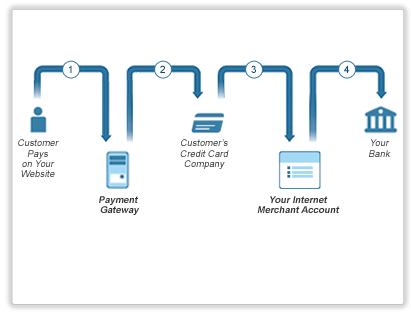
Banks are reluctant as there are no signatures involved nor is the card present in such transactions. A third party processor is basically a merchant account cum payment gateway rolled into one.
Let’s read more about third party processors and credit card merchant accounts-
1. A Boon for New Businesses
Small businesses that are launching a new product in the market can avail the services of a third party credit card processor; usually, they are not sure if their product will do well in the market or not. A third party credit card processor will accept orders by credit on behalf of the business.


2. Select a Merchant Account or a Third Party Processor
If the sales volume of a business entity is less than $1000 a month and it has limited funds, then it should venture out with a third party credit card processor in the first stage. They might charge more than a merchant account but for a good reason.
3. Switch to A Credit Card Merchant Account As The Business Grows
Once the merchant feels that his business model is actually working, he can upgrade his business to a credit card merchant account. Some of these accounts also come with a shopping cart and don’t forget that time bound contracts are involved too.  
4. Things to Keep In Mind
Before deciding to go for a third party credit card processor, be very clear about the fees, the AVS costs and availability of additional fraud protection packages.